Help · Frequently asked questions
Frequently
asked questions.
The questions that come up most, grouped by theme: before coming, medical, ceremony, contribution, after, contact, framing. If your question is not here, write to us.
A page of answers can never replace a conversation. But before writing, many people ask themselves the same questions — about preparation time, health, the length of the stay, the contribution, what happens afterwards. Here is what we answer most often. Read what speaks to you, then come and talk to us.
Before coming
Preparation and timing.
How long does it take to prepare a visit to Ebando?
Allow 2 to 4 months minimum between your first contact and the session. If the next session is in 6 weeks, it is probably not the right one for you. Preparation time is essential, neither an administrative delay nor a detail. See How to prepare your visit.What is the pre-initiation questionnaire?
A document to complete ahead of your visit. It helps the team understand your motivations, your general state of health, your history. You fill it in directly on your own device: nothing is sent or saved online, your answers stay on your phone or computer. You then download it as a PDF and send it to the team yourself by WhatsApp or by email at OngEbando@gmail.com. See The questionnaire.What medical exams do I need before coming?
Three exams, to be done with a doctor before your visit: an electrocardiogram (ECG), a liver test and a blood pressure check. You send the results to Ebando by email. They are not optional: Iboga is a powerful plant, and these exams make sure your heart and liver are ready to receive it. See How to prepare your visit.Do I need to be sober before the initiation?
Yes. You must be free of all substances (medicinal plants, drugs, alcohol, medication) for the two weeks before the initiation. No strict diet is required, but a pure and healthy way of eating is encouraged. Honesty about your consumption is essential to how the ceremony unfolds: declare everything in the questionnaire, leaving nothing out.What should I bring for the stay?
Light cotton clothing (long sleeves and trousers protect against mosquitoes), what you need for the nearby beach (swimsuit, hat, sunscreen, towel or sarong), a mosquito repellent, your yellow fever vaccination card and the balance of the initiation in cash (euros), with notes of €10, €20 or €50. And an open heart. A small gift for the team is always appreciated, though nothing is required.What are the session dates in 2026?
One session is scheduled from 1 to 12 August 2026. Session dates are set by the team across the year; write to Ebando to learn the next ones and find out which leaves you the preparation time needed — allow 2 to 4 months between first contact and the ceremony.
Medical
Health, contraindications, experience.
What are the medical contraindications?
Iboga interacts with several molecules (antidepressants, antipsychotics, certain heart medications). Pre-existing heart conditions, severe liver conditions, or serious psychiatric history, are contraindications. Any ongoing medication must be declared in the pre-initiation questionnaire. The Ebando team is not a medical team, the opinion of your treating physician is required.Do you need prior experience with other plants?
No. Many people initiated at Ebando had no prior experience with any plant whatsoever. What matters is not accumulated experience, it is a clear intention, compatible health, a moment in life that makes the visit possible.How do I guard against malaria and yellow fever?
Yellow fever vaccination is mandatory to enter Gabon: without a valid certificate, entry may be refused, or a quarantine imposed. Against malaria, Ebando recommends Artemisia annua (sweet wormwood) as a natural prevention, or a treatment such as Malarone on medical advice. Lariam (mefloquine) is not suitable; ask your travel doctor for advice. On site, Pemba can also prepare a natural remedy. See Visa and logistics.
Ceremony
Duration, rhythm, languages.
How long does the stay last?
An initiation session lasts 12 days. The duration is set by the Ebando team. The central ceremony night is a single one, but the entire stay — preparation, accompaniment, integration on site — is an integral part of the journey. See Day-by-day programme.What languages are spoken at Ebando?
The team communicates fluently in French and English — write and exchange in either one. Tatayo and the team also speak several Bantu languages (notably Fang and Massango), needed for the rites. Visitors of other languages generally plan to communicate in French or English during their stay.What does a typical day during the stay look like?
The first days are for arrival, acclimatisation and rest. Then come the blessing in the forest, the plant baths (up to three times a day) and the purification ceremonies that prepare the body. The central ceremony begins in the evening and lasts all night, followed by several days of recovery, then a final ceremony of blessing. The rhythm varies with each person's process. See Day-by-day programme.Can I film, photograph or record during the stay?
Not freely. Always ask permission before photographing: for sacred elements, a contribution from 10,000 CFA is requested. And it is strictly forbidden to record the musicians, for legal reasons. These rules protect the tradition and those who carry it; they are not negotiable.What is the “Cutting the cord” ritual?
An optional traditional ritual, for a fresh start. If you carry habits tied to substances or medication, this powerful rite helps free you from old patterns and open a new chapter. It is requested from the team and added to the initiation contribution.
Contribution
Rates and payment.
How much does an initiation cost?
The contribution is not shown online: it is shared with you directly by the association during your first exchange. It includes accommodation, meals, accompaniment and post-ceremony support. To this are added only the visa and entry fees to Gabon. See Contribution and conditions.How is the contribution paid?
By bank transfer, to be confirmed directly with Ebando. No online payment, no third-party platform. The deposit is paid before the visit; the balance, on arrival or in advance depending on what is agreed with the team.What exactly does the contribution include?
It covers the essentials of the stay: the airport transfer, the accommodation (private room or comfortable tent on the terrace), the fresh, local meals, and all the initiation rites along with the team's accompaniment. It is lived in a spirit of fair participation rather than a fixed price, and is shared with you during your exchange. See Contribution and conditions.Are there costs on top of the contribution?
Yes, a few costs remain yours to pay on arrival: the visa via M'bolo Tours (around €220, confirmed by the team). Yellow fever vaccination is mandatory: without a valid certificate, entry may be refused. Optional: the “Cutting the cord” ritual, extra nights or extra meals if you arrive before or leave after the session, whose terms are shared by the team. Everything is paid in cash, in euros. See Visa and logistics.
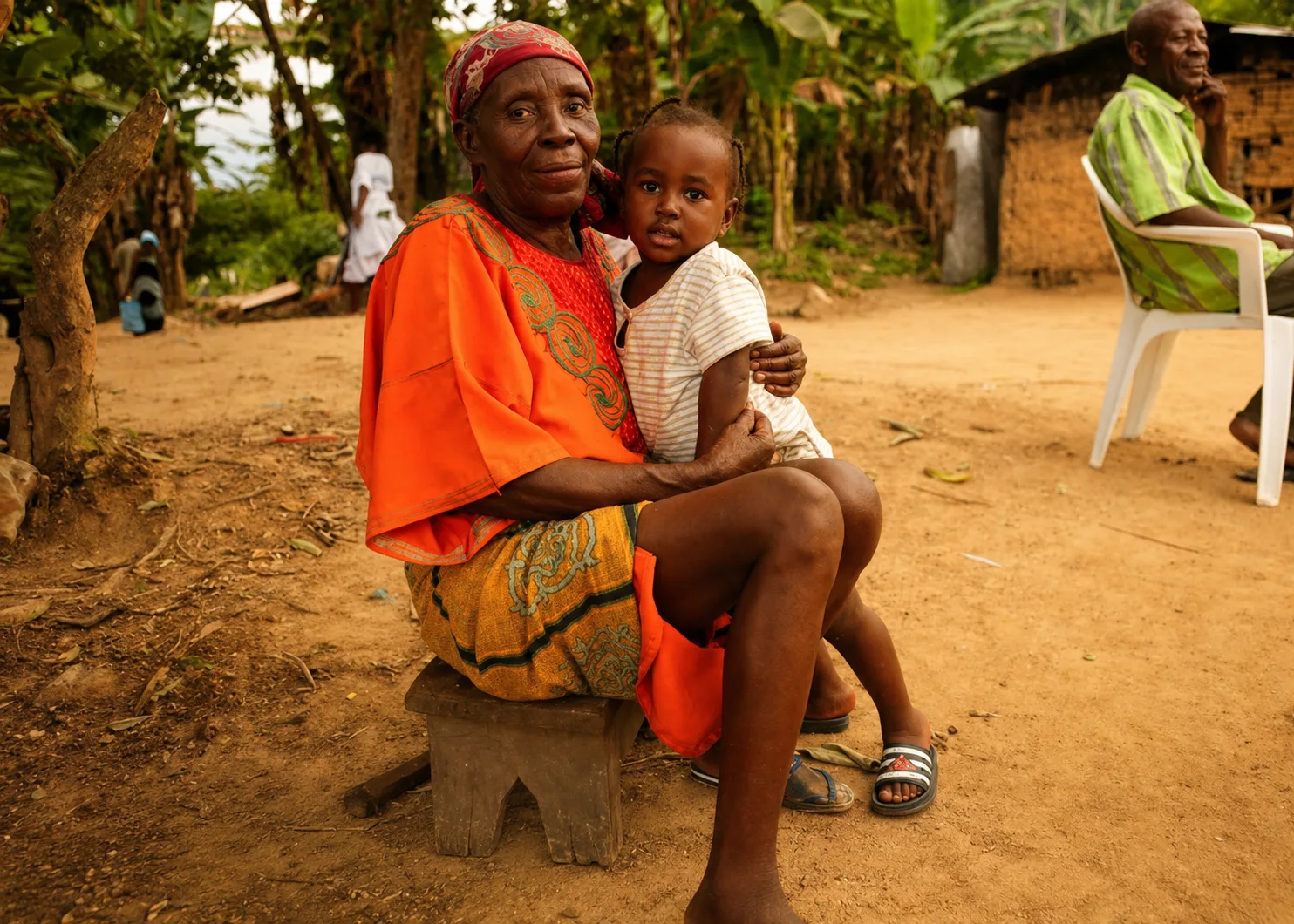
The time of preparation
“ An initiation is not something that can be rushed. It takes time, and patience. ”
— Tatayo
After
Integration and follow-up.
What is post-initiation integration?
After the ceremony, a process of integration begins — one that lasts several months. Sobriety (alcohol, drugs, overstimulation) for 4 to 6 months minimum. A gradual return to daily life. No major life decisions in the following weeks. Follow-up through listening, advice and a connection with Ebando if needed. See After the initiation.
Contact
How to write.
How can I contact you?
First and foremost by WhatsApp — it is the most direct, and the team answers there fluently in French and English. Email remains available at OngEbando@gmail.com. The Contact page also offers a form: it opens WhatsApp (or your email client) with your request already drafted, storing nothing on the site. No automated chat, no telephone switchboard: you write, the team reads you.
Framing
What we are.
Is Ebando a retreat, a therapeutic stay, a tourist centre?
None of the three. Ebando is a Gabonese non-profit association, dedicated to passing on the Bwiti traditions in the Fang (Dissumba) and Missoko-Ngondey na Dipuma (Simba school) lineages. It is neither a wellness retreat, nor a tourist stay. See The association.Is the Bwiti a religion, a therapy, a drug?
The Bwiti is an ancestral Gabonese initiatory tradition, passed on in several lineages (Fang Dissumba, Missoko-Ngondey, Mitsogho, Apindji, first peoples). It is neither a religion in the modern sense, nor a drug in the hedonic sense. It is a framework, a cosmology and a path of knowledge. Iboga, the sacred plant of the Bwiti, is used within a precise ritual framework. See Iboga and Bwiti.
A living question is worth more than a ticked answer.
— Ebando
Your question is not here?
Write to Ebando. We take the time to answer.
We read every message, and we will add the question to this page if it comes up often.