
The association · Testimony
A letter, films, institutions and media outlets. The ties that the work of Tatayo and the forest peoples has woven over the years, attested and documented.
In the beginning, a letter
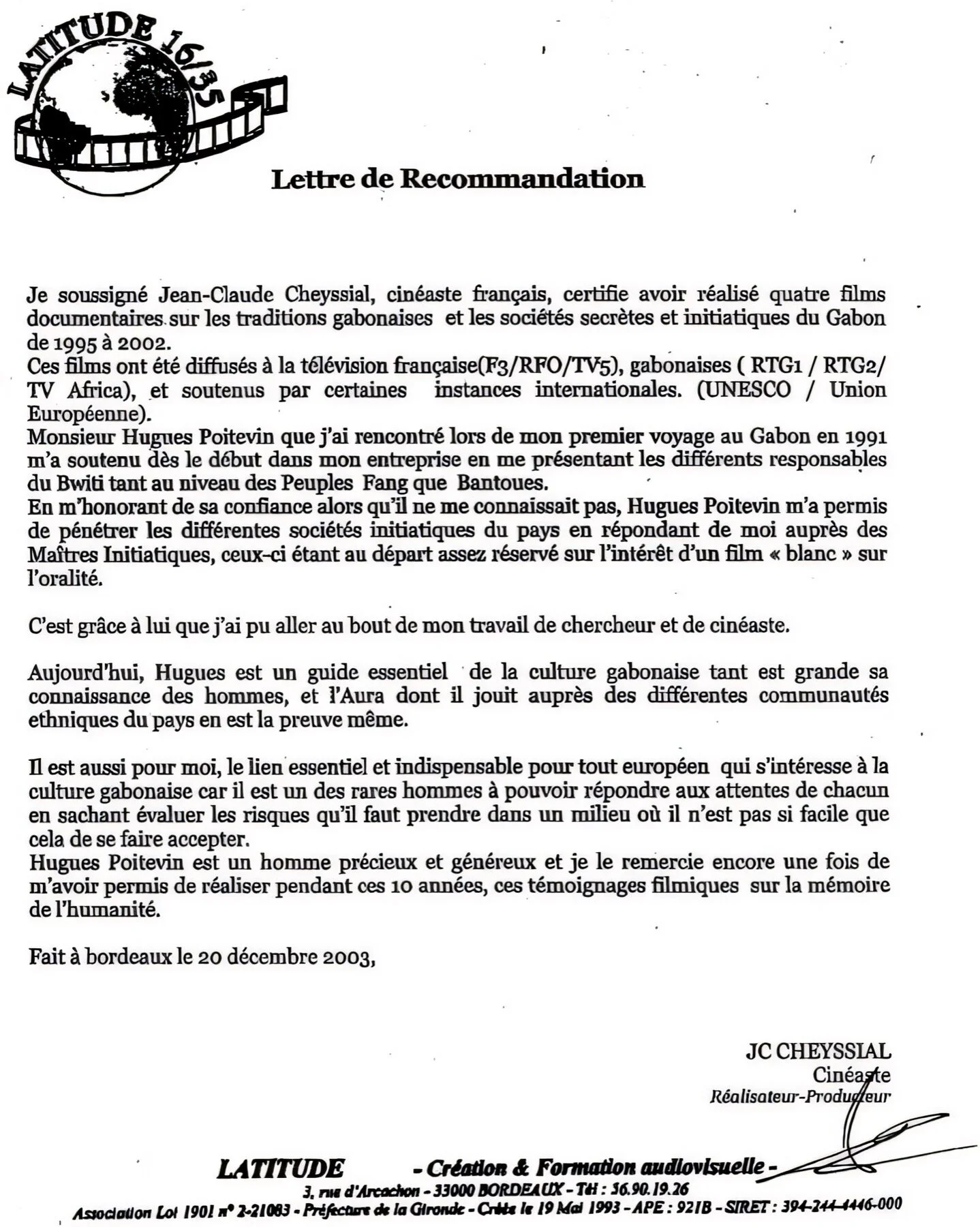
In December 2003, in Bordeaux, filmmaker Jean-Claude Cheyssial wrote a letter. In it he recounts a meeting, in Gabon in 1991, that made possible ten years of documentary work on the country's initiatory traditions. This testimony, the oldest in Ebando's possession, opens this page.
Letter of recommendation · 20 December 2003 · Bordeaux
I, the undersigned, Jean-Claude Cheyssial, French filmmaker, certify that I directed four documentary films on Gabonese traditions and the secret, initiatory societies of Gabon between 1995 and 2002.
These films were broadcast on French television (F3/RFO/TV5) and Gabonese television (RTG1/RTG2/TV Africa), and supported by certain international bodies (UNESCO / European Union).
Mr Hugues Poitevin, whom I met during my first trip to Gabon in 1991, supported me from the outset in my undertaking, introducing me to the various figures of the Bwiti, among both the Fang and the other peoples of Gabon.
By honouring me with his trust although he did not know me, Hugues Poitevin allowed me to enter the country's various initiatory societies by vouching for me to the master initiators, who were at first quite reserved about the value of a “white man's” film on oral tradition.
It is thanks to him that I was able to see through my work as a researcher and filmmaker.
Today, Hugues is an essential guide to Gabonese culture, so great is his knowledge of its people, and the standing he enjoys among the country's various ethnic communities is the very proof of it.
He is also, for me, the essential and indispensable link for any European interested in Gabonese culture, for he is one of the few men able to meet everyone's expectations while knowing how to assess the risks that must be taken in a setting where it is not so easy to be accepted.
Hugues Poitevin is a precious and generous man, and I thank him once again for allowing me, over these ten years, to make these filmed testimonies of the memory of humankind.
JC Cheyssial · Filmmaker · Director-producer
Latitude · Audiovisual Creation & Training · Bordeaux
Original document

It is thanks to him that I was able to see through my work as a researcher and filmmaker.
— Jean-Claude Cheyssial, letter of 20 December 2003
They also recommended Tatayo
Three international productions.
Beyond Jean-Claude Cheyssial, three international productions worked with Tatayo in Gabon in the 2000s and recommended him in writing.
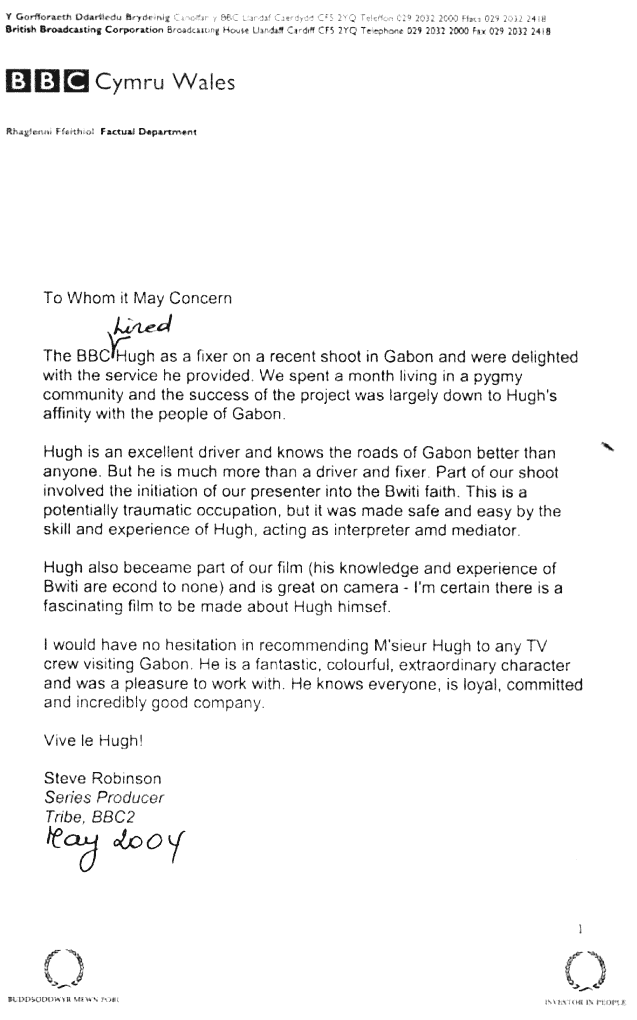
“Part of our shoot involved the initiation of our presenter into the Bwiti faith. This is a potentially traumatic occupation, but it was made safe and easy by the skill and experience of Hugh, acting as interpreter and mediator.”
In 2004, the BBC hired Tatayo as a fixer for the Gabon shoot of the series Tribe (the Babongo episode).
Steve Robinson · Series Producer, Tribe · BBC Two
May 2004
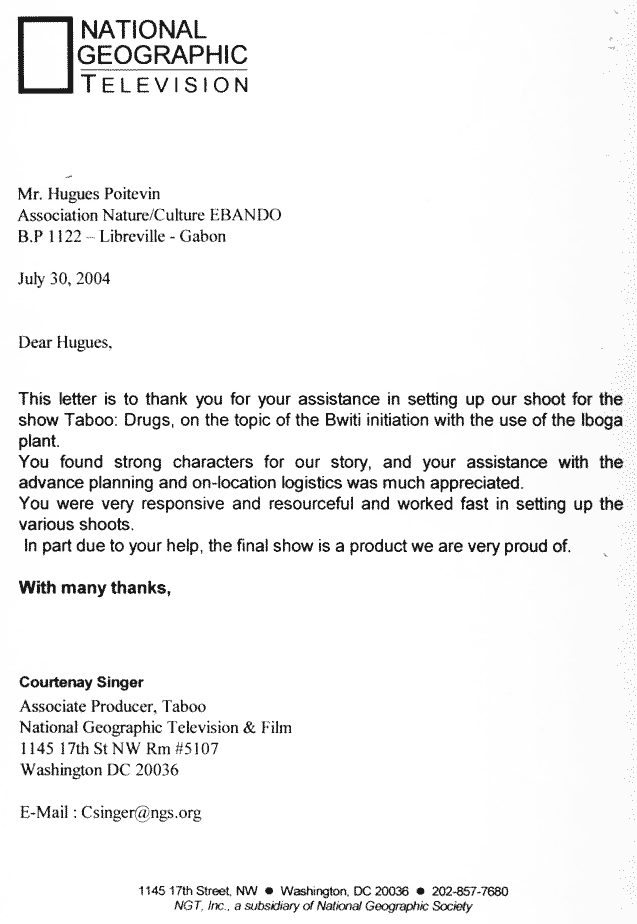
“You were very responsive and resourceful and worked fast in setting up the various shoots. In part due to your help, the final show is a product we are very proud of.”
In 2004, National Geographic called on Tatayo to set up the shoot for the show Taboo: Drugs, on Bwiti initiation and Iboga.
Courtenay Singer · Associate Producer, Taboo · National Geographic Television & Film
30 July 2004
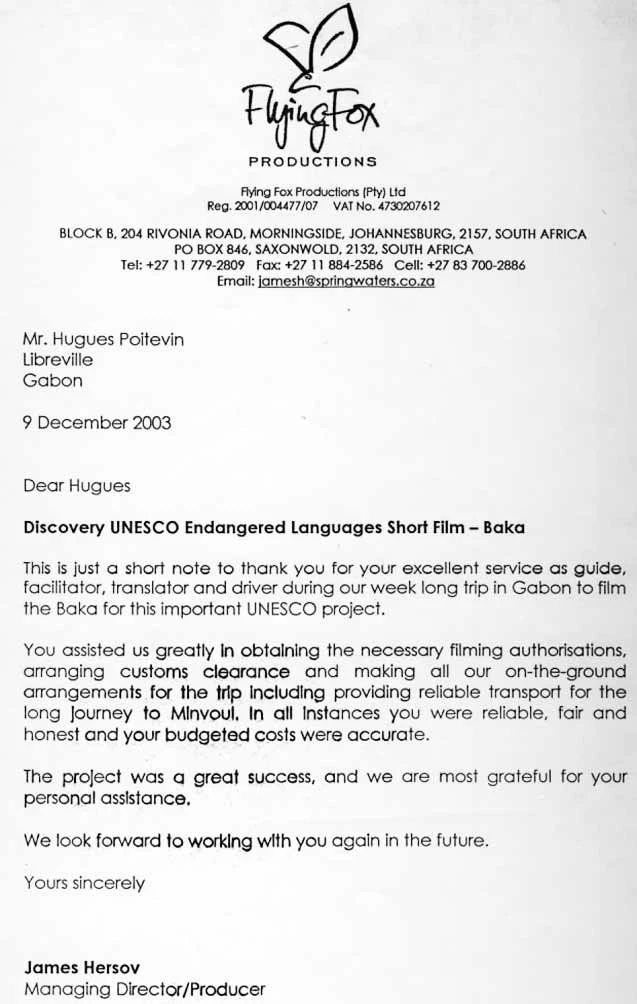
“Thank you for your excellent service as guide, facilitator, translator and driver during our week long trip in Gabon to film the Baka for this important UNESCO project. In all instances you were reliable, fair and honest.”
In 2003, Flying Fox Productions (Johannesburg) called on Tatayo as guide and translator for a Discovery / UNESCO short film on endangered languages, focused on the Baka, up to Minvoul.
James Hersov · Managing Director / Producer · Flying Fox Productions
9 December 2003
Films cited
Four documentaries.
Between 1995 and 2002, Jean-Claude Cheyssial directed four documentary films on Gabonese traditions and the secret initiatory societies of Gabon. Broadcast on French channels (France 3, RFO, TV5) and Gabonese channels (RTG1, RTG2, TV Africa), with institutional support from UNESCO and the European Union.
His meeting with Tatayo in 1991 — during his first trip to Gabon — was the starting point of a decade-long collaboration. Tatayo played a key role in making introductions to the master initiators of the various Bwiti traditions.
Beyond the letter
Press, media
& institutional references.
Over the years, the work of Tatayo and the forest peoples has crossed paths with researchers, filmmakers and institutions. Here are the references and collaborations documented to date.

Omar Bongo University · Libreville
Gabonese academic institution, encountered in the documentation work on the traditions of the forest peoples.

Utrecht University
Dutch university whose research work has been connected with Ebando's fieldwork.

Bruce Parry · Tribe (BBC)
British BBC documentary series whose episode on the Babongo benefited from on-the-ground mediation.

Babongo People's Association
Partner community and association, at the heart of the transmission of the forest's traditions.

Jean-Claude Cheyssial · Filmmaker
Independent director, author of the letter of recommendation reproduced above.

UNESCO · European Union
International bodies that supported the broadcast of the documentary films on Gabonese traditions, mentioned in the letter above.

TV5MONDE
International French-language channel that featured Ebando and Gabon's traditions.

RTG · Gabon
Radiodiffusion Télévision Gabonaise, Gabon's national broadcaster, which featured Ebando.
RTP · Portugal
Rádio e Televisão de Portugal, the Portuguese public broadcaster, which featured Ebando.
Articles, episodes & podcasts
In the press & the media.
France 24 / AFP
2025Iboga, a sacred plant in Gabon
View sourceATTMind #130
2020Iboga & the Bwiti School of Life (Tatayo)
View sourceUniverse Within
2020Ep. 27 — Tatayo: Iboga, Bwiti & Gabon
View sourceCeiba Foundation
2020Bwiti: School of Life
View sourceICEERS
2026The future of iboga — perspectives from Central Africa
View sourceKiwi.com
2017Gabon — the next drug tourism destination
View sourceIboga.org
2010Medicine Man — Dr. Deandrea visits Tatayo
View sourceLe Monde
2012A root with hallucinatory powers
View sourceJeune Afrique
2014Of European origin, they became Gabonese, Senegalese… and now live on the continent
View source
In the field
Partners.
- View site
Blessings of the Forest
An initiative dedicated to preserving Iboga and the forest together with Gabon's communities, for a fair sharing of their benefits. Ebando is listed among its partners.
- View site
Gabon Untouched · Libreville
A Gabonese conservation, ecotourism and sustainable-development organisation working in Gabon's deep forest. Ebando is listed among its partners.
On screen
On video.
Ebando's own voice, the music of the temple, and the view of the international press.
More ceremonies, songs and ngombi in the playlist “My Bwiti, 2009-2010” (47 videos filmed at Ebando). See also the AFP report, “In Gabon, an initiatory tourism for Westerners”.
References cited on the basis of documented collaborations and mentions. Logos remain the property of their respective owners.