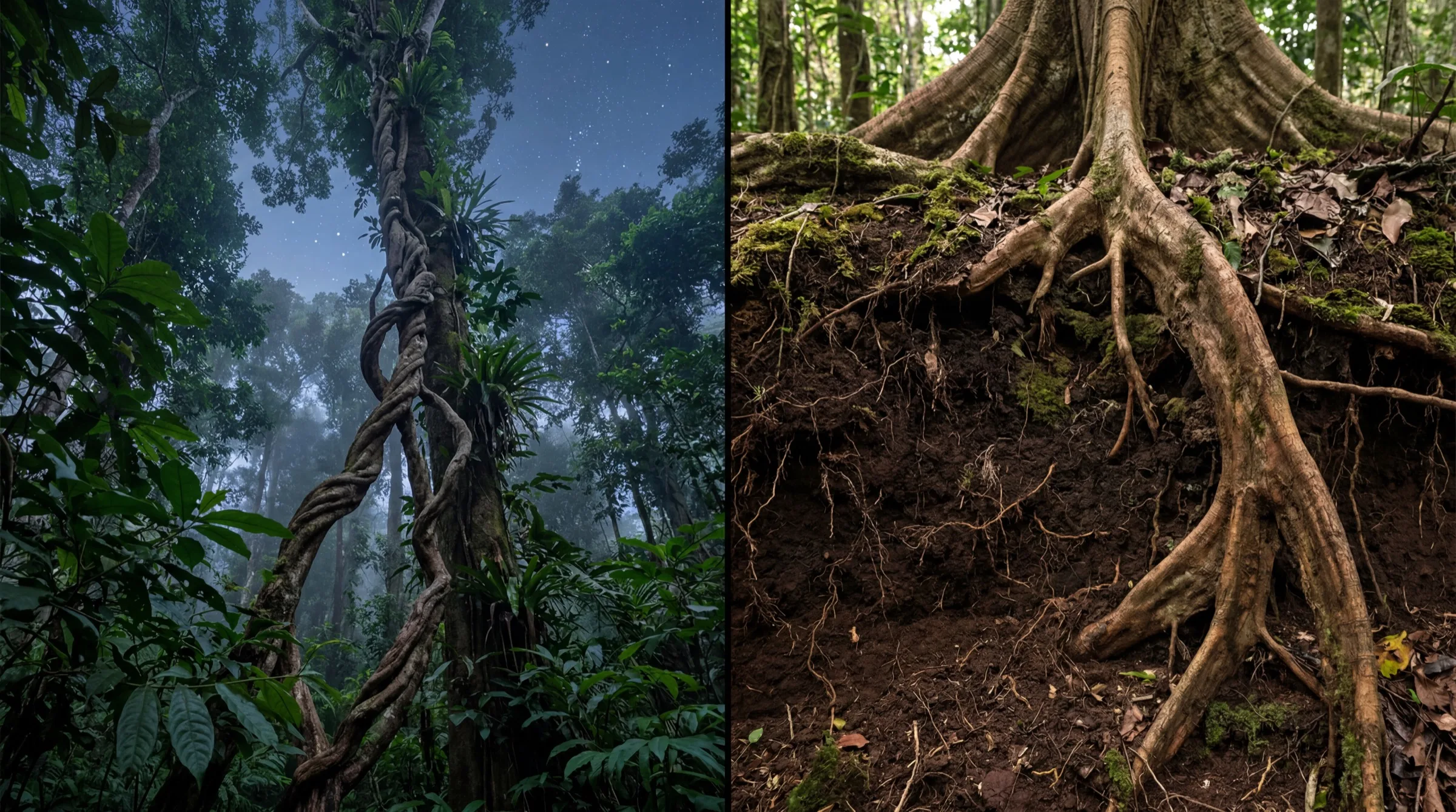
Two medicines · One summit
In one sentence
Separated by an ocean and cultures that could not be more different, iboga (the sacred root of Gabon) and ayahuasca (the vine of the Amazon) share one function: suspending, for a moment, the illusion of the “self” to let something else surface.
One teaches how to fly, the other how to walk. Here is, without hierarchy and backed by sources, what brings them together, what sets them apart, and why so many researchers move from one to the other.
Setting out the two plants
Not “drugs”, living traditions.
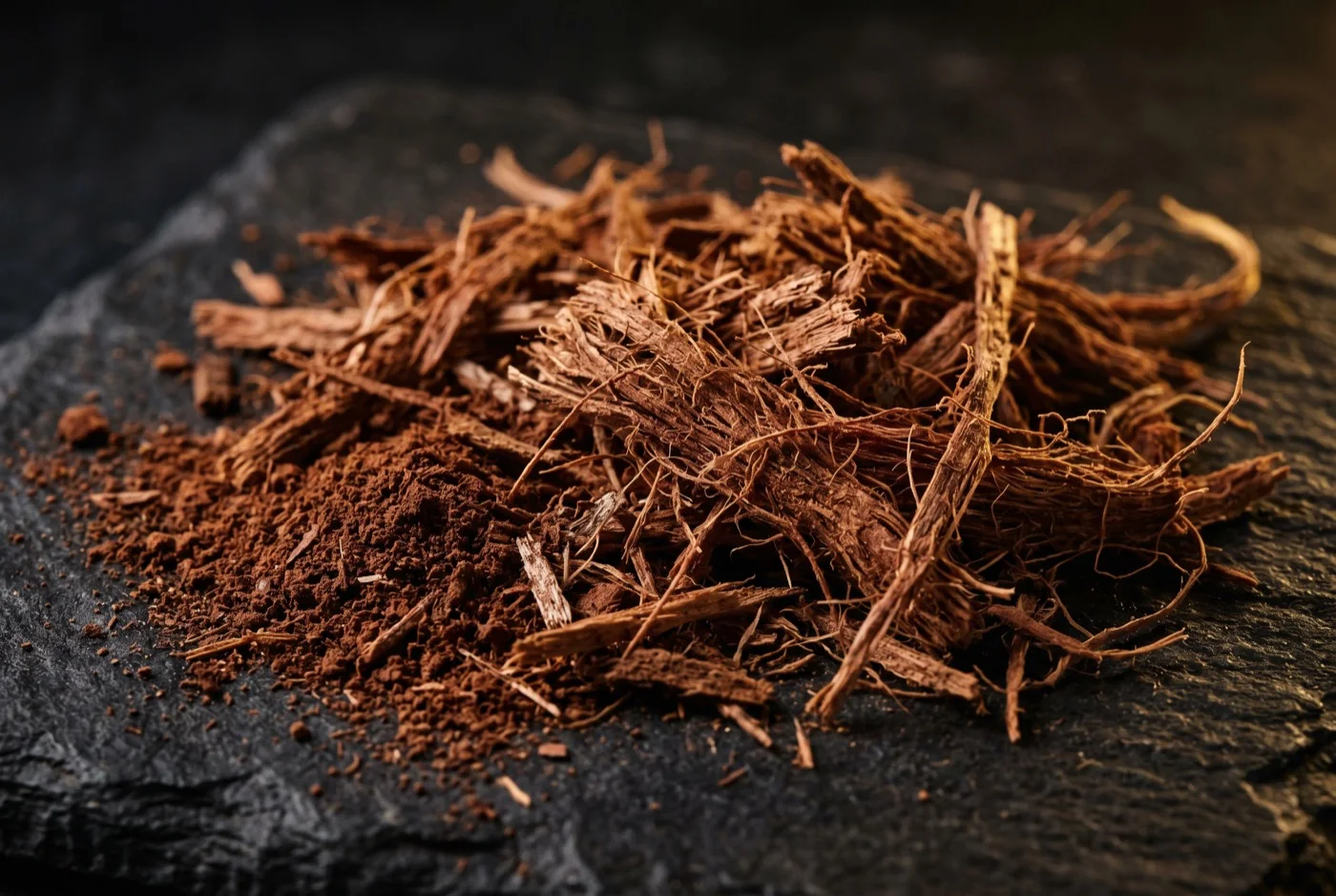
Iboga
Tabernanthe iboga, root bark; main indole alkaloid: ibogaine. Heart of the Bwiti initiation rites, in Central Africa.
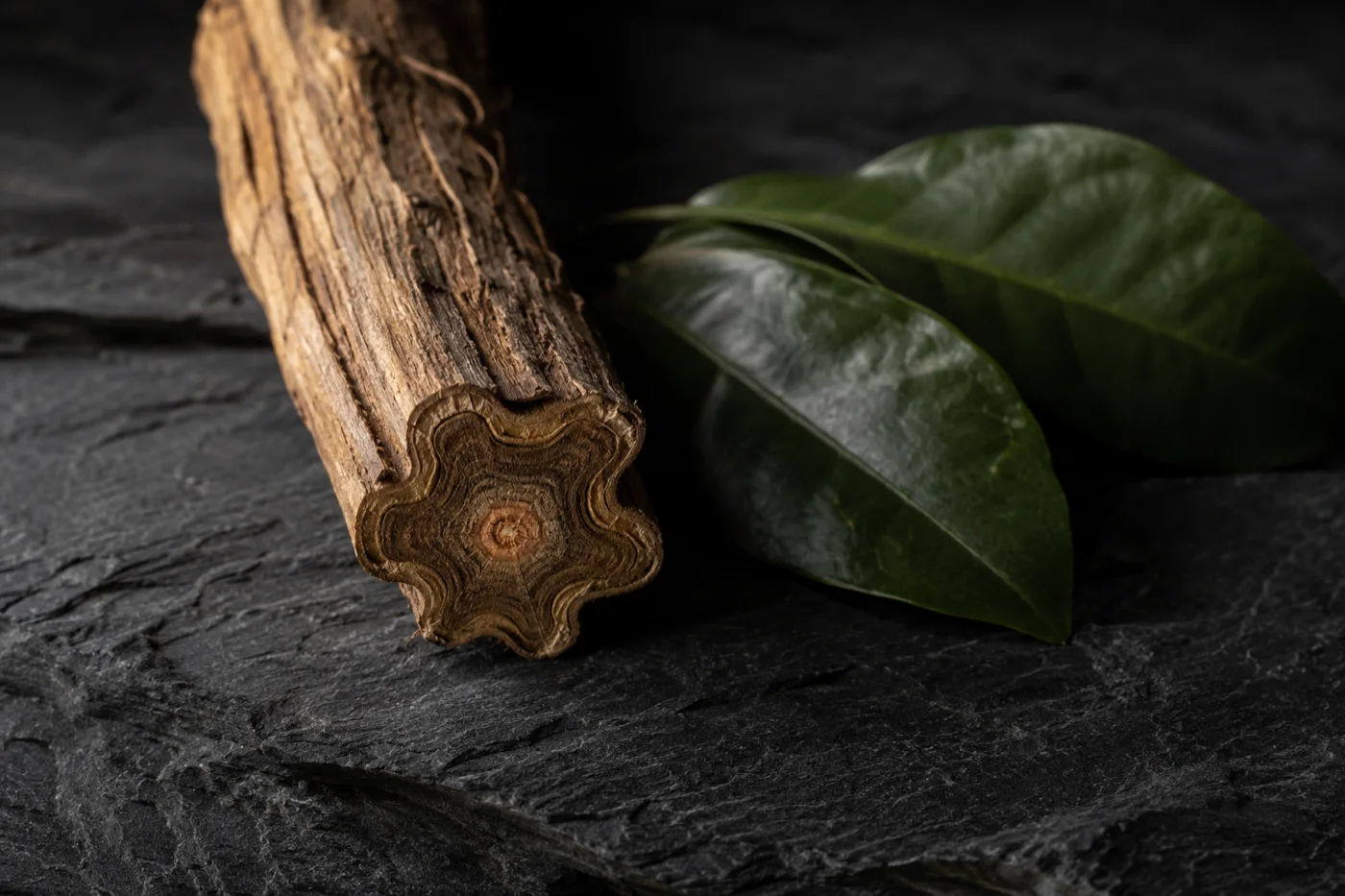
Ayahuasca
Decoction of Banisteriopsis caapi (beta-carbolines, MAOIs) + Psychotria viridis; visionary principle: DMT. Shamanic use of the Amazon basin.
The doorways of awakening
Two plants, one mirror-effect.
Both are taken within a ritual setting, never recreationally. Both open a profound introspection, often described as a face-to-face with oneself. Both are studied today by research (addiction, post-traumatic stress). And both require preparation, a setting and screening, never improvisation.
Seven aspects, two equal columns
Their complementarity is read in their differences.
| Aspect | Iboga | Ayahuasca |
|---|---|---|
| Plant & main alkaloid | Tabernanthe iboga, root bark; main indole alkaloid: ibogaine. | Decoction of Banisteriopsis caapi (beta-carbolines, MAOIs) + Psychotria viridis; visionary principle: DMT. |
| Origin & tradition | Central Africa (Gabon, Cameroon, Congo). Heart of the Bwiti initiation rites. | Western Amazon basin. Shamanic and religious use, with documented spread mainly recent (last few centuries). |
| Ceremony format | Most often a single, long initiatory intake, over one night (and beyond). | Several sessions of a few hours each, often spread over several nights. |
| Duration of effects | Long experience: about 18 to 36 hours, in successive phases (visionary, introspective, residual). | Short experience: about 4 to 8 hours, onset in 20 to 60 minutes, peak around the 1st–2nd hour. |
| Nature of the experience | "Oneirogenic" state (waking dream), visions mainly internal, introspective and autobiographical. | Visions often with eyes open/closed, frequent purgative dimension (ritual vomiting). |
| Cardiac monitoring | Prior ECG and cardiac assessment required: ibogaine lengthens the QT interval (risk of arrhythmia). | No documented QT risk of its own; main vigilance on MAOI interactions (medications, foods). |
| Cultural purpose | Initiation rite: passage, meeting with the ancestors, search for truth about oneself. | Healing, purge, vision and guidance within an Amazonian shamanic framework. |
Plant & main alkaloid
- Iboga
- Tabernanthe iboga, root bark; main indole alkaloid: ibogaine.
- Ayahuasca
- Decoction of Banisteriopsis caapi (beta-carbolines, MAOIs) + Psychotria viridis; visionary principle: DMT.
Origin & tradition
- Iboga
- Central Africa (Gabon, Cameroon, Congo). Heart of the Bwiti initiation rites.
- Ayahuasca
- Western Amazon basin. Shamanic and religious use, with documented spread mainly recent (last few centuries).
Ceremony format
- Iboga
- Most often a single, long initiatory intake, over one night (and beyond).
- Ayahuasca
- Several sessions of a few hours each, often spread over several nights.
Duration of effects
- Iboga
- Long experience: about 18 to 36 hours, in successive phases (visionary, introspective, residual).
- Ayahuasca
- Short experience: about 4 to 8 hours, onset in 20 to 60 minutes, peak around the 1st–2nd hour.
Nature of the experience
- Iboga
- "Oneirogenic" state (waking dream), visions mainly internal, introspective and autobiographical.
- Ayahuasca
- Visions often with eyes open/closed, frequent purgative dimension (ritual vomiting).
Cardiac monitoring
- Iboga
- Prior ECG and cardiac assessment required: ibogaine lengthens the QT interval (risk of arrhythmia).
- Ayahuasca
- No documented QT risk of its own; main vigilance on MAOI interactions (medications, foods).
Cultural purpose
- Iboga
- Initiation rite: passage, meeting with the ancestors, search for truth about oneself.
- Ayahuasca
- Healing, purge, vision and guidance within an Amazonian shamanic framework.
The neurobiology
What the science establishes, and what it does not establish.
An opening point of caution: ayahuasca and iboga do NOT act on the brain in the same way. This is precisely what makes them complementary. Each claim is sorted by level of evidence, with its source.
- Fact
DMT (the visionary principle of ayahuasca) acts notably as an agonist at serotonergic 5-HT2A receptors, a target shared with the classic serotonergic psychedelics. It is a poorly selective ligand, which also affects other receptors (5-HT1A, 5-HT2C, sigma-1).
Smith et al., "Agonist properties of N,N-dimethyltryptamine at serotonin 5-HT2A and 5-HT2C receptors", Pharmacol. Biochem. Behav., 1998 ↗ - Fact
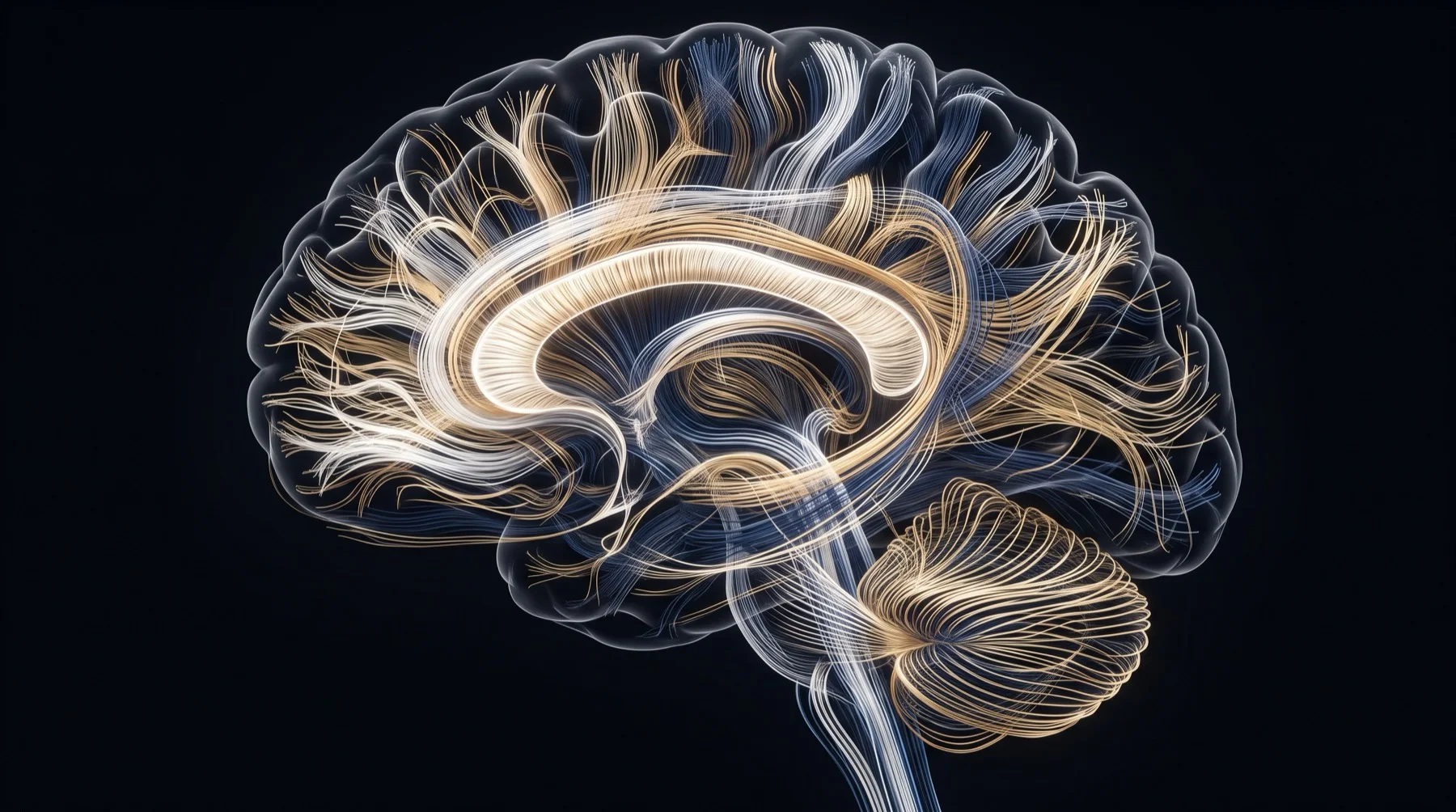
In functional MRI (10 experienced volunteers), ayahuasca decreases the activity and connectivity of the default mode network (DMN), notably its main hubs (posterior cingulate/precuneus, medial prefrontal cortex). The authors' own term is "modulates": a decrease, not an abolition.
Palhano-Fontes et al., "The Psychedelic State Induced by Ayahuasca Modulates the Activity and Connectivity of the Default Mode Network", PLoS ONE, 2015 ↗ - Fact
Ibogaine blocks the NMDA (glutamate) receptor as an open-channel blocker, demonstrated in vitro and in vivo. NMDA is only ONE of its targets: its pharmacology is multi-target (NMDA, opioid, sigma-2, serotonin transporter, nicotinic receptors).
Chen et al., "Ibogaine block of the NMDA receptor: in vitro and in vivo studies", Neuropharmacology, 1996 ↗ - Hypothesis
In rats and mice, a single dose of ibogaine increases expression of the neurotrophic factor GDNF in the midbrain (ventral tegmental area), an effect associated with reduced alcohol consumption. Result observed in animals; not established in humans.
He et al., "GDNF Mediates the Desirable Actions of the Anti-Addiction Drug Ibogaine against Alcohol Consumption", Journal of Neuroscience, 2005 ↗ - Fact
Ibogaine is converted by the liver into noribogaine, an active metabolite with a long half-life (about 24 to 50 hours in healthy volunteers). This is what explains iboga's prolonged duration of action.
Glue et al., "Ascending-dose study of noribogaine in healthy volunteers", J. Clin. Pharmacol., 2015 ↗ - Fact
Ibogaine is classified as "oneirogenic": at high doses it induces states close to a waking dream, eyes closed, while remaining in contact with the surrounding environment, hence the image of a "life review". The content of the visions itself belongs to subjective experience.
González et al., "Ibogaine Acute Administration in Rats Promotes Wakefulness, Long-Lasting REM Sleep Suppression…", Frontiers in Pharmacology, 2018 ↗ - Fact
A fundamental difference not to be conflated: ayahuasca is a classic serotonergic psychedelic (5-HT2A action, documented DMN effect in humans), whereas iboga is an ATYPICAL psychedelic whose action does not mainly go through 5-HT2A. No human imaging has shown that iboga "deactivates the DMN": that would be an unwarranted extrapolation.
Review "Beyond the 5-HT2A Receptor: Classic and Nonclassic Targets in Psychedelic Drug Action", Journal of Neuroscience, 2023 ↗
From vision to embodiment
Complementary, not rivals.
Far from opposing each other, Iboga and ayahuasca are often experienced as complementary, two medicines, two paths that answer one another.
Iboga
The masculine
the father, structure, verticality, the confrontation with one's own truth.
Ayahuasca
The feminine
the mother, water, emotion, letting go, gentleness.
Symbolic reading shared by many practitioners and traditions, a felt sense, not a scientific claim.
A frequent trajectory
From ayahuasca to iboga: why this bridge?
In plant-medicine communities, a recurring pattern emerges: people who have worked with ayahuasca for a long time describe, over time, a "call" toward iboga. This passage is almost always recounted as a progression along a path, never as a prescription.

- Experience
The passage from one plant to the other is frequently experienced as a natural step on the path: "most people who meet one of these two mistresses eventually end up facing the other".
Evren Gunes, practitioner (Gaya Kali center), "Iboga Vs. Ayahuasca" ↗ - Experience
A felt "call" toward iboga after a long relationship with ayahuasca: a practitioner recounts that, after about fifty ayahuasca ceremonies, he only felt this pull toward iboga "recently", when the call became clear.
Luke Miller, Heart Centred Living blog (2026) ↗ - Experience
A recurring reading: where ayahuasca reveals itself "piece by piece" over repeated ceremonies, iboga is described as going straight to the root and presenting "the whole puzzle" in a single passage.
Convergent accounts (Julia Christina; Root Healing Inc.) ↗ - Experience
Some people present ayahuasca as the school that teaches how to hold through long discomfort, and iboga as a "reset" that comes later, when the call becomes more insistent.
Beth Weinstein, "Iboga, Ibogaine and Why We Need to Get This Right" ↗ - Hypothesis
The archetype "open/expand" (ayahuasca, relational and visionary) vs. "ground/confront" (iboga, introspective, direct life review) is fairly consistent across reports to serve as a reference point, but experiences vary considerably from person to person.
MahaDevi, "Iboga Vs Ayahuasca: 7 Critical Differences" ↗ - Hypothesis
A caution shared across these same circles: do not chain medicines together. Leave a significant amount of time (often cited: one to three months minimum) between iboga and another plant, and remember that the quality of the setting, medical screening, facilitator, integration, matters more than the substance.
Meraki Tribe ("Ultimate Guide to Iboga"); Jason Grechanik (facilitator) on how deeply personal these experiences are ↗
Everything that follows belongs to lived testimony and practitioners' readings, not to a scientific demonstration. The descriptions "ayahuasca opens / iboga grounds" are archetypes shared within the community, useful as a reference point but nuanced by wide individual variability: the setting often matters more than the plant.
Editorial honesty: if iboga "calls", it remains physically demanding. It lengthens the heart's QT interval (risk of arrhythmia) and requires cardiac screening and a serious setting. The call never replaces preparation.
Neither one is a shortcut
The plant opens a door; it is the seeker who walks.
These plants do not “give” awakening: they show, confront, disorganise the known, and all the work begins afterward, in integration. What heals is not the substance alone, but the setting that surrounds it: preparation, the presence of a guide, the meaning one gives to what was seen.
Questions fréquentes
Iboga & ayahuasca: frequently asked questions
- Iboga or ayahuasca, which one to start with?
- There is no “right” order: it depends on the person, their history and their support setting. Many meet ayahuasca first, but that is an observation from the field, not a rule.
- Can the two be combined?
- Not within the same period. Practitioners recommend a significant gap between two medicines (often one to three months), and iboga additionally requires prior cardiac screening. Chaining plants too quickly is discouraged.
- Which one is more “powerful”?
- They cannot be measured on the same scale: durations, mechanisms and purposes differ profoundly. “Stronger” does not mean much here; these are two distinct paths, not a competition.
- Why do so many people move from ayahuasca to iboga?
- It is a frequent pattern in testimonies (see the dedicated section on this page), experienced as a passage from opening to grounding. It is a felt sense shared by many practitioners, not a law or a protocol.
- Is it dangerous?
- Iboga carries a real cardiac risk (QT interval lengthening) that requires an ECG and a serious setting; ayahuasca mainly requires vigilance around MAOI interactions (medications and foods). Neither is to be improvised.
For educational purposes, based on the sources cited on this page. This is not medical advice: Ebando is not a medical team, and your doctor's opinion remains required.
If iboga is calling you, the Bwiti tradition is transmitted within a precise framework.
Discover the initiation at Ebando