
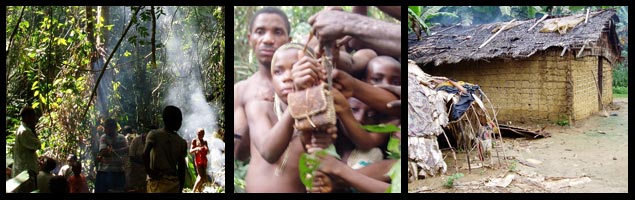
Project · Education · Oumba district
An education programme for Babongo children under fifteen, in Ngounié province, Tsamba-Magotsi department. An education adapted to their culture, one that later allows integration into Gabon's public schools.
The motivation
In Ngounié province, Tsamba-Magotsi department, and more precisely in the Oumba district, lives a people robbed by isolation, deprived of the means of education that are nonetheless, today, the key to the development of the human being. Given the scale that education is taking on in the world at large, and in Gabon in particular, the children of the Oumba district should have access to it too, despite their remoteness.
The idea is not to import a school model foreign to their reality. On the contrary: to adapt the curriculum to forest culture, to bring in traditional skills in the afternoons, and to free up the mornings for the official school curriculum of Gabon's Ministry of National Education.
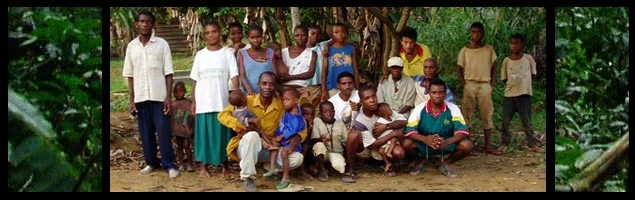
General objective
Contributing to the education of Babongo children under fifteen.
Giving Babongo children access to education, in a setting that respects their cultural identity and prepares their future integration into the public schools that all Gabonese now have access to.
The programme covers basic school supplies, the teachers' materials, and a work plan adapted to the rhythms of the village.
Materials needed
The tools that keep a classroom running.
A school in the heart of the forest runs on very little: something to write with, something to draw a blackboard, something to mark with. Every supply is earmarked, simple, and goes straight to the village.
- 01Books, notebooks, slates
- 02Ordinary pencils, coloured pencils, pens, felt-tips
- 03Erasers, pencil sharpeners
- 04Plywood for the blackboard
- 05Tins of black paint, chalk
- 06Set square, protractor, ruler
- 07Books for the teacher
Work plan
A pedagogy that fits.
Four stages, from the first contact with families through to the end-of-year assessment.
One · Raising awareness
Convincing parents of how much education matters, so they let the children study — including on rest days.
Two · Curriculum and rhythm
The school curriculum is the one set by the Ministry of Education. Only the timetable changes: mornings for modern teaching, afternoons mixed (modern plus traditional and cultural).
Three · Follow-up
The teacher visits the children during rest hours and days to check their willingness to work outside class. Excursions into the forest are organised to connect daily life with school education.
Four · Assessment
An end-of-school-year assessment is carried out for each child.
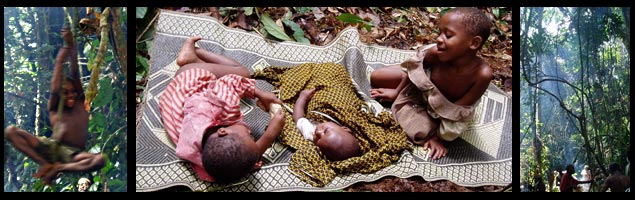
Linking school and forest
Learning without disowning who you are.
The mornings follow the official curriculum. The afternoons blend modern teaching with traditional skills. The teacher stays with the children even on their rest days, and excursions into the forest connect what they live with what they learn.
To support is to commit
Support Babongo education.
A few notebooks, a blackboard, a teacher's materials: that is all that stands between a village and a first classroom. Write to Ebando to support this project.